





The CEnTR* System

CEnTR*SEEK

Community-engaged research is happening across your institution right now. Most of it is invisible, distributed across websites, reports, course descriptions, and publications that were never designed with discoverability in mind.

CEnTR*SEEK reads that text and finds the engagement. No self-reporting. No siloed databases. No additional burden on faculty, staff, or partners.

Botanical illustration of a fern with exposed root system

Finding what's already there, without asking anyone to report it.

CEnTR*SEEK doesn't ask people to report their work. It finds the work in text that already exists.

Traditional approaches rely on self-reporting, keyword searches, or manual review, all of which systematically miss work that doesn't describe itself in the expected terms. Engaged scholarship often uses different language than traditional research, and the communities it serves rarely appear in the databases institutions use to measure impact.

CEnTR*SEEK transforms dispersed institutional text into structured representations of engagement, giving institutions a comprehensive, accurate picture of their community-engaged landscape without creating new administrative burden.
  1. Sources
    Sources

    Accepts file-based inputs — PDFs, CSVs, structured text — or a root URL from which the system crawls institutional domains, extracting content with metadata while respecting rate limits and robots.txt. Transformer-based embeddings capture meaning beyond keyword matching, recognizing engagement even when it does not use expected vocabulary.

  2. Signals
    Signals

    The system reads extracted text for indicators of community engagement: language of partnership, reciprocity, community voice, and shared purpose. Because engaged scholarship often describes itself in terms that differ from traditional research, signal detection operates on meaning rather than keywords alone.

  3. Patterns
    Patterns

    A combination of machine learning models and rule-based logic assesses engagement across five dimensions: Partnership and Power, Community Voice, Process and Methods, Outcomes and Impacts, and Sustainability. Every classification includes highlighted excerpts and plain-language rationales that explain how the determination was made.

  4. Understanding
    Understanding

    Structured JSON objects include classification labels, confidence scores, and supporting excerpts, designed for interoperability with CEnTR*MAP and CEnTR*IMPACT, and for translation into human-readable summaries for researchers, administrators, and community partners.

CEnTR*SEEK is not an opaque judge. It is an analytical partner, one that shows its work and invites the humans closest to the community to interpret what it finds.

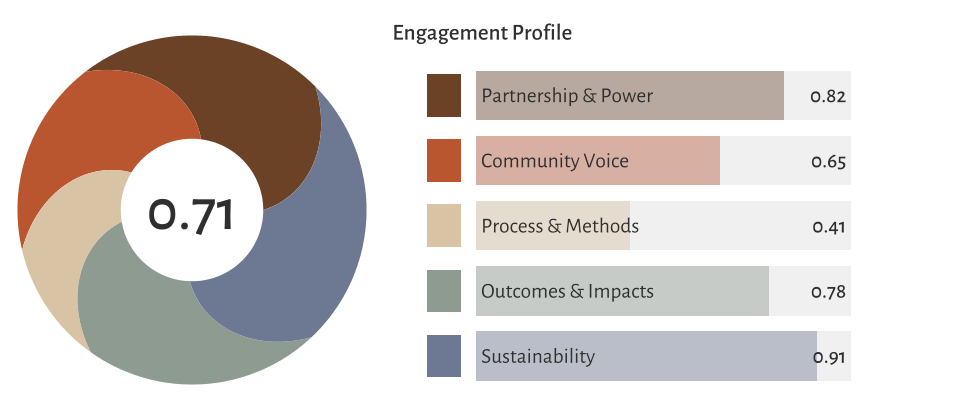
Sample engagement profile showing scores across five classification dimensions: Partnership and Power 0.82, Community Voice 0.65, Process and Methods 0.41, Outcomes and Impacts 0.78, Sustainability 0.91. Composite score: 0.71.
What Becomes Possible

From invisible to legible, at institutional scale.

Surface Hidden Work

Identify faculty and staff doing community-engaged work who are not yet connected to institutional collaborative structures, including work that falls outside traditional scholarly channels.

Reveal Patterns

Surface engagement patterns across departments, neighborhoods, or partner types to inform strategic coordination and resource allocation, without waiting for annual surveys.

Support Documentation

Generate structured data from existing institutional text that supports evaluation, accreditation, and reporting, reducing the documentation burden on researchers and partners.

Demonstrate Scope

Make the full landscape of institutional engagement legible to funders, accreditors, and leadership, in terms that reflect what the work actually is, not just what gets formally reported.

Ready to see what's already there?

CEnTR*SEEK is in active development. If your institution is interested in piloting the system or contributing to its design, we'd like to talk.